Jordi Bolibar1,2, Antoine Rabatel1, Isabelle Gouttevin3, Clovis Galiez4, Thomas Condom1, and Eric Sauquet2
1 Univ. Grenoble Alpes, CNRS, IRD, G-INP, Institut des Géosciences de l’Environnement
(IGE, UMR 5001), Grenoble, France
2 INRAE, UR RiverLy, Villeurbanne, Lyon, France
3 Univ. Grenoble Alpes, Université de Toulouse, Météo-France, CNRS, CNRM,
Centre d’Études de la Neige, Grenoble, France
4 Univ. Grenoble Alpes, CNRS, Grenoble INP, LJK, Grenoble, France
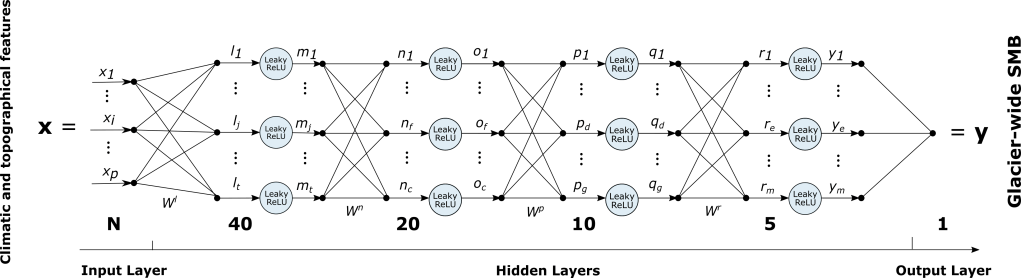
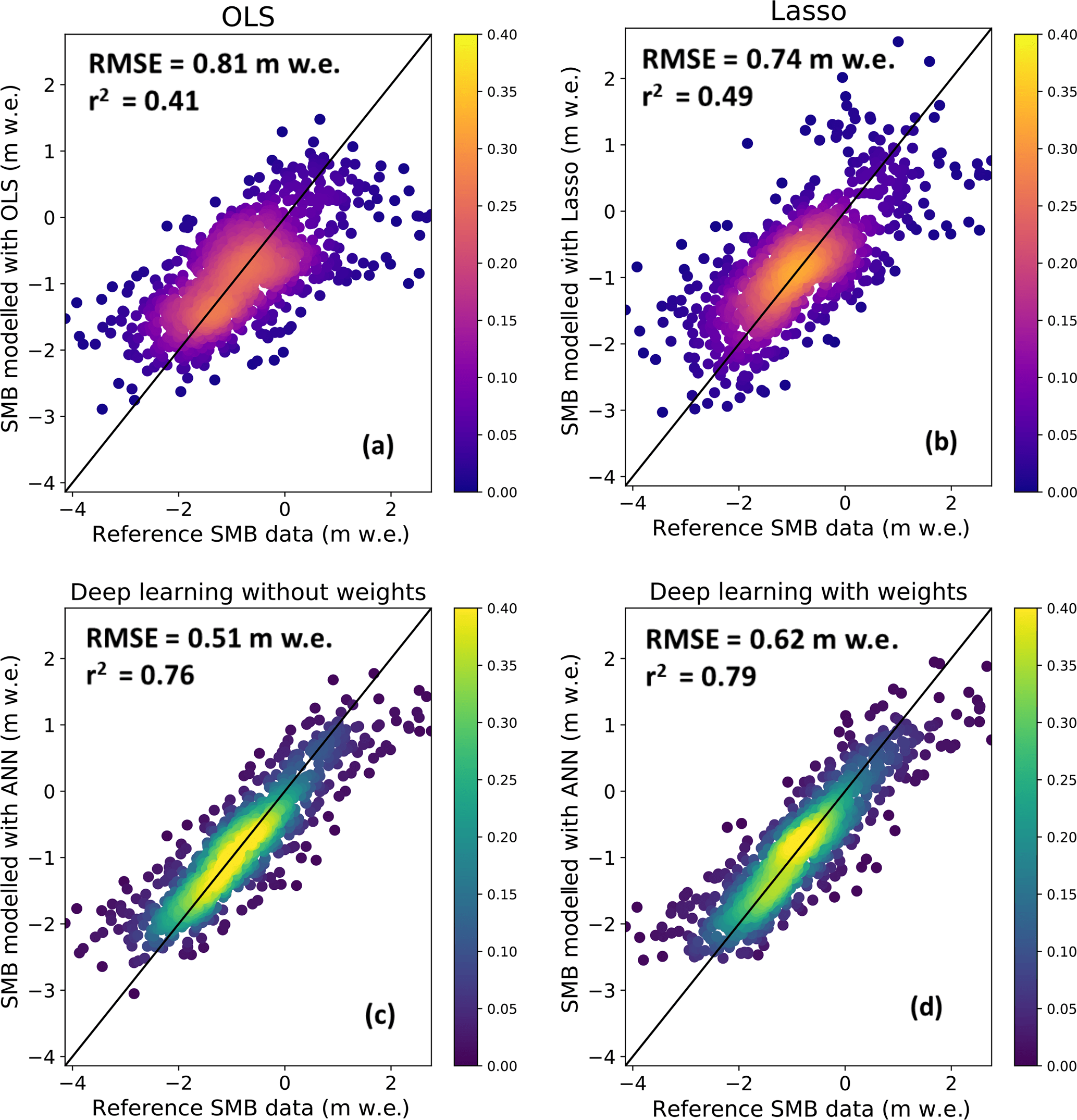
Abstract. We present a parameterized glacier evolution model, with a surface mass balance (SMB) component based on a deep artificial neural network (i.e. deep learning). While most glacier models tend to incorporate more and more physical processes, here we take an alternative approach by creating a parameterized model based on data science. Annual glacier-wide SMBs can be simulated using either deep learning or Lasso (regularized multilinear regression), whereas the glacier geometry is updated using a glacier-specific parameterization. We compare and cross-validate our nonlinear deep learning SMB model against other standard linear statistical methods on a dataset of 32 French alpine glaciers. Deep learning is found to outperform linear methods, with improved explained variance (up to +64 % in space and +108 % in time) and accuracy (up to +47 % in space and +58 % in time), resulting in an estimated r2 of 0.77 and RMSE of 0.51 m.w.e. Substantial nonlinear structures are captured by deep learning, with around 35 % of nonlinear behaviour in the temporal dimension. For the glacier geometry evolution, the main uncertainties come from the ice thickness data used to initialize the model. These results should encourage the use of deep learning in glacier modelling as a powerful nonlinear tool, capable of capturing the nonlinearities of the climate and glacier systems, that can serve to reconstruct or simulate SMB time series for individual glaciers at a regional scale for past and future climates.
Full access to the paper here: https://www.the-cryosphere.net/14/565/2020/
Access to the ALPGM GitHub repository: https://github.com/JordiBolibar/ALPGM
 Jordi Bolibar
Leave a comment