Glaciers and ice caps are experiencing strong mass losses worldwide, challenging water
availability, hydropower generation, and ecosystems. Here, we perform the first-ever glacier
evolution projections based on deep learning by modelling the 21st century glacier evolution
in the French Alps. By the end of the century, we predict a glacier volume loss between 75
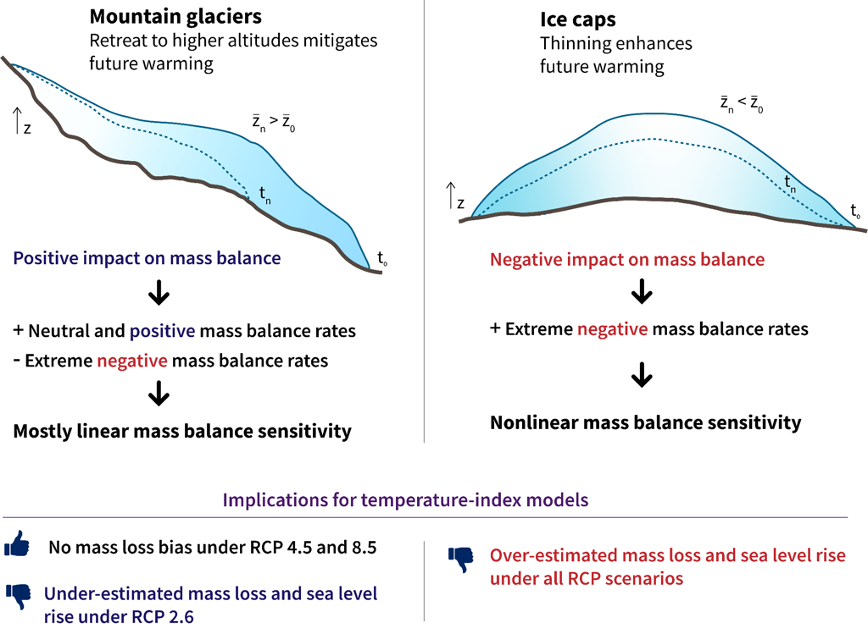
and 88%. Deep learning captures a nonlinear response of glaciers to air temperature and
precipitation, improving the representation of extreme mass balance rates compared to linear
statistical and temperature-index models. Our results confirm an over-sensitivity of
temperature-index models, often used by large-scale studies, to future warming. We argue
that such models can be suitable for steep mountain glaciers. However, glacier projections
under low-emission scenarios and the behaviour of flatter glaciers and ice caps are likely to
be biased by mass balance models with linear sensitivities, introducing long-term biases in
sea-level rise and water resources projections.
Article available in open-access: https://www.nature.com/articles/s41467-022-28033-0
 Jordi Bolibar
Leave a comment