Christian Torres a b , Deniz Bozkurt b c d, Tomás Carrasco-Escaff c, Jordi Bolibar e, Jorge Arigony-Neto a
aInstitute of Oceanography, Federal University of Rio Grande, Brazil
bDepartment of Meteorology, University of Valparaíso, Chile
cCenter for Climate and Resilience Research (CR)2, Chile
dCenter for Oceanographic Research COPAS COASTAL, Universidad de Concepción, Chile
eDepartment of Civil Engineering and Geosciences, Delft University of Technology, Netherlands
https://www.sciencedirect.com/science/article/abs/pii/S092181812400153X
Abstract
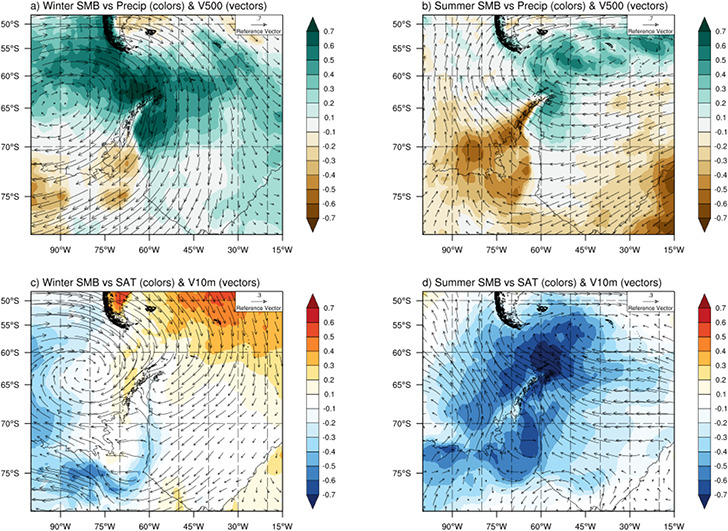
Few studies have assessed a comprehensive understanding of how the seasonal and interannual variability and trends of the surface mass balance (SMB), including the influence of atmospheric river (ARs), are governed by the climate on the South Shetland Islands (SSI) glaciers located in the northerly Antarctic Peninsula (AP). To address this gap, we comprehensively analyzed the correlations and regressions between seasonal and annual SMB with regional to global climate indices and a state-of-the-art AR tracking database from 1980 to 2019. The daily and monthly SMB was obtained from two physical glaciological models, which was verified against 19 years of annual and seasonal glacier-wide SMB observations available in three glaciers (Johnsons, Hurd, and Bellingshausen), showing a good ability to capture interannual and seasonal variability. Results indicate a low dependence of the SMB on main atmospheric modes of variability (e.g., El Niño-Southern Oscillation and the Southern Annular Mode), and a moderate dependence on regional climate indices based on atmospheric pressure anomalies and sea surface temperature anomalies over the Drake Passage. Furthermore, our findings reveal that ARs have different effects on the SMB depending on the season. For example, winter ARs tend to boost accumulation due to increased snowfall, while summer ARs tend to intensify surface melting due to increased sensible heat flux. Our study highlights the Drake Passage as a key region that has the potential to influence the interannual and seasonal variability of the SMB and other climate variables, such as air temperature and snowfall over the SSI. We suggest that future work should consider this region to better understand the past, present and future climate changes on the SSI and surrounding areas.
 Jordi Bolibar
Leave a comment