Lucille Gimenes, Romain Millan, Nicolas Champollion, and Jordi Bolibar
Abstract
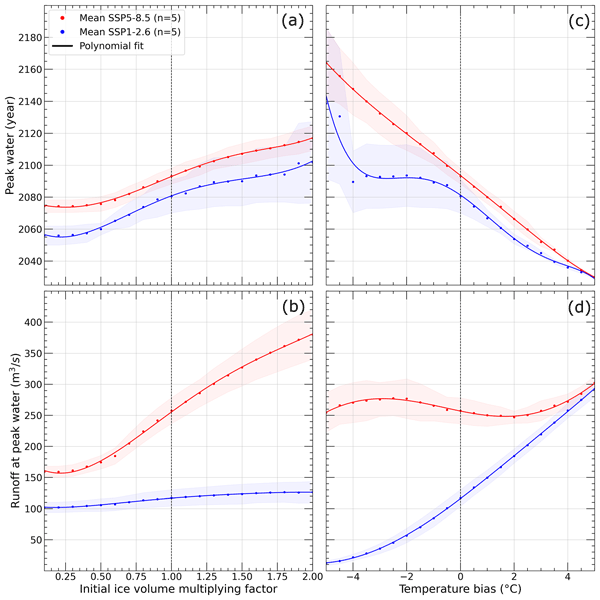
This study investigates the sensitivity of peak water in the Western Kunlun Mountains of the Tibetan Plateau. Using the Open Global Glacier Model (OGGM), we analyze how variations in inverted initial ice volume and temperature climate forcing under different Shared Socioeconomic Pathways (SSP) affect peak water timing and magnitude. We compare two global ice thickness datasets, revealing substantial differences in the projected peak water timing and magnitude. The results highlight that smaller initial ice volumes lead to earlier peak water occurrences, particularly under the SSP5-8.5 scenario. Temperature bias also notably influences the peak water timing by delaying its date in the region by roughly 13 years for each bias degree. These findings underscore the importance of accurate ice thickness estimates and climate projections for predicting future water availability and informing water management strategies in glacier-dependent regions.
Full text: https://tc.copernicus.org/articles/20/171/2026/
How to cite.
Gimenes, L., Millan, R., Champollion, N., and Bolibar, J.: Brief communication: Sensitivity analysis of peak water to ice thickness and temperature: A case study in the Western Kunlun Mountains of the Tibetan Plateau, The Cryosphere, 20, 171–182, https://doi.org/10.5194/tc-20-171-2026, 2026.
 Jordi Bolibar
Leave a comment