Marijn van der Meer, Harry Zekollari, Alban Gossard, Kamilla Hauknes Sjursen, Jordi Bolibar, Matthias Huss, Daniel Farinotti
Full access: https://agupubs.onlinelibrary.wiley.com/doi/10.1029/2026JH001250
Abstract
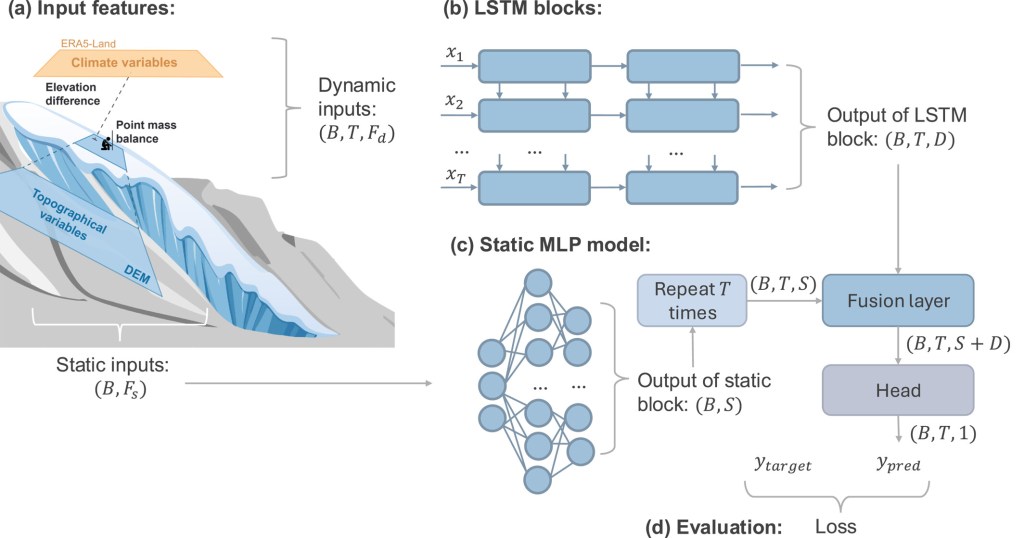
Glacier mass balance (MB) is a key indicator of climate change and a central driver of glacier evolution, yet most glaciers worldwide lack long-term in situ measurements. For estimating glacier MB, data-driven models provide a complementary alternative to traditional numerical approaches by learning empirical relationships between climate forcing, topography, and MB from observations. Here, we develop a recurrent neural network (RNN) based on a Long Short-Term Memory (LSTM) architecture within the Mass Balance Machine (MBM) framework to predict winter and annual point surface MB across the Swiss Alps. MBM is trained on 30,000 observations from 30 glaciers and tested on eight glaciers excluded from training to assess spatial generalization. MBM predicts winter and annual MB with high accuracy on unseen glaciers (root mean squared error of 0.35 and 0.78 m w.e.). Its recurrent structure enables learning temporal dependencies, improving the representation of seasons with strong accumulation or ablation. Beyond point predictions, MBM generates spatially distributed MB maps that capture MB gradients, and produce glacier-wide mass changes consistent with geodetic estimates. Monthly outputs further show that MBM reproduces the seasonal transition from winter accumulation to summer ablation with realistic timing and magnitude. These results show that a RNN can recover key characteristics of glacier MB dynamics and that the learned relationships transfer effectively across the climatic and topographic settings of the Swiss Alps. The demonstrated generalization skill highlights the potential of MBM for application in regions with limited direct measurements, though transferability to glaciers with fundamentally different climatic and topographic settings remains to be established.
Plain Language Summary
Glacier retreat poses big challenges, making it vital to understand how climate affects glaciers. However, direct measurements of glacier change are limited. We developed a machine-learning model, the Mass Balance Machine (MBM), that can estimate how glaciers gain or lose mass, even when few observations are available. Unlike conventional approaches that treat each month independently, MBM is based on a LSTM network, a type of deep learning model that learns from sequences of data over time, recognizing that a glacier’s state in any given month depends on conditions in preceding months. As input, MBM uses climate and topographical variables. MBM can accurately predict both winter and annual glacier mass changes, even for glaciers not included in its training data. It also produces detailed maps showing how mass balance varies across entire glaciers, and these closely match independent reference data. In addition, the model successfully reproduces the seasonal cycle of the glacier’s mass change. These results show that machine learning that accounts for temporal memory can capture key features of glacier behavior, and this approach offers a promising way to estimate glacier change in remote regions where traditional monitoring is difficult.


Leave a Reply